Deep in Ghana’s Eastern Region, in a forest reserve that has been described as one of the most ecologically important landscapes in all of West Africa, something unusual is happening. A mining company is not just cleaning up after itself. It is actively working to make the forest better than it found it. The Atewa …
Deep in Ghana’s Eastern Region, in a forest reserve that has been described as one of the most ecologically important landscapes in all of West Africa, something unusual is happening.
A mining company is not just cleaning up after itself. It is actively working to make the forest better than it found it.
The Atewa Range Forest Reserve is a Globally Significant Biodiversity Area — a designation reserved for places of exceptional ecological value.
Home to rare and threatened species found almost nowhere else on earth, it sits within a band of Upland Evergreen Forest that stretches across only a narrow corridor of West Africa. Scientists have described it as irreplaceable.
It is here, in this remarkable landscape, that Zijin Golden Ridge Limited (ZGRL) — operator of the Akyem Gold Mine — has launched what it describes as Ghana’s first large-scale mining biodiversity offset. The Zijin Atewa Biodiversity Offset Project is a 10-year conservation programme implemented in partnership with the Forestry Commission of Ghana.
It is designed to achieve No Net Loss of biodiversity.
What does net loss actually mean?
The concept of a biodiversity offset is relatively straightforward in principle, even if it is complex in practice. When a mining company operates in a forest, it inevitably affects the environment.
Some of those effects — cleared vegetation, disturbed soil — can be addressed through reclamation and replanting. ZGRL has already done that. The company has planted 317 hectares of plantation forest to compensate for the 101 hectares of the Ajenjua Bepo Forest Reserve impacted by mining — exceeding its legal requirement of 303 hectares.
But there are ecological impacts that trees alone cannot fix. When a forest is cleared, wildlife loses habitat. Threatened species are displaced. The complex web of ecological relationships that took centuries to develop is disrupted in ways that a plantation cannot replicate. These are what scientists call ‘residual impacts’ — and they are what a biodiversity offset is designed to address. “Reforestation addresses what can be seen. The biodiversity offset addresses what cannot.”
The Atewa offset programme measures its progress not in trees planted, but in Quality Hectares
— an internationally recognised metric that quantifies biodiversity value as a function of both the area and the ecological quality of habitat.
ZGRL’s target is 371 Quality Hectares of gain over 10 years. This is enough to fully compensate for the residual biodiversity impacts of mining at the Akyem Mine. Current projections suggest the programme can exceed that target even under the most conservative management assumptions.
Why Atewa?
The choice of the Atewa Range Forest Reserve as the offset site was not arbitrary. Credible biodiversity offsets require that gains occur in an ecologically comparable location — a place that shares key characteristics with the impacted site, and where conservation gains can be permanently protected. The Atewa Reserve fits both criteria.
Like the Ajenjua Bepo Forest Reserve where ZGRL mines, Atewa falls within the Upland Evergreen Forest zone — one of the rarest forest types in Africa. And as a Globally Significant Biodiversity Area, Atewa’s forests cannot be subjected to commercial timber harvesting. Any gains achieved there are permanent.
The forest also presents significant conservation opportunity. Illegal mining, agricultural encroachment, and logging have degraded parts of the reserve. Targeted intervention which will include strengthened protection, natural regeneration, and active planting, can deliver meaningful and measurable ecological improvement.
Communities at the hart of it
The programme is not only about trees and ecological metrics. From its earliest stages, ZGRL and its partners engaged more than 44 communities surrounding the Atewa Forest Reserve. Their participation shaped the Biodiversity Offset Management Plan and the socioeconomic feasibility assessment that underpins it.
During the enrichment planting pilot conducted in 2022, more than 200 community members were employed in planting and restoration activities. The results were striking: a 64.6 percent seedling survival rate across 60 hectares, supervised by the Resource Management Support Centre of the Forestry Commission.
Looking ahead, the programme includes a dedicated agroforestry component targeting 250 hectares of integrated farm-tree systems across 50 selected communities. This will help improve soil health and crop yields while reducing pressure on the forest. Longer-term, ecotourism livelihood opportunities are being developed to create sustainable income streams tied directly to the health of the Atewa Reserve.
2026: A year of scale
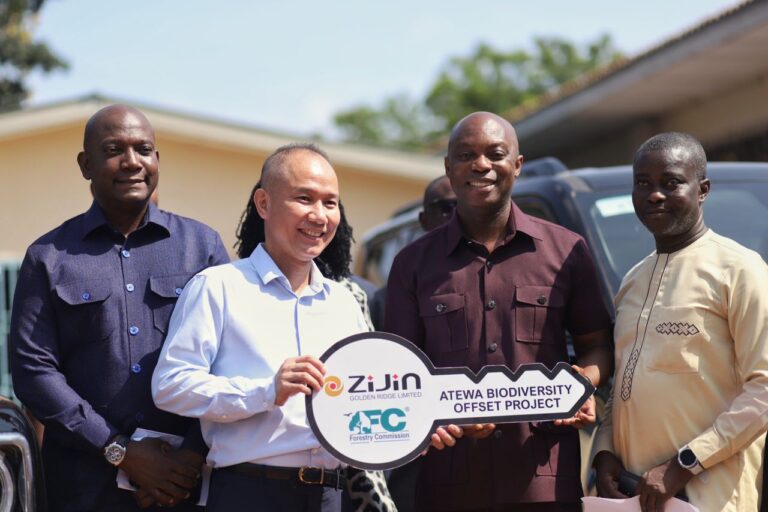
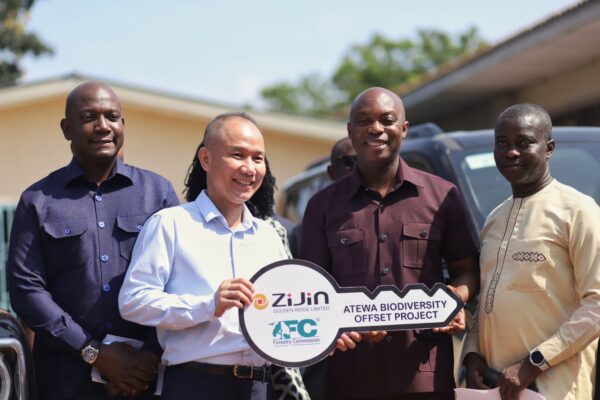
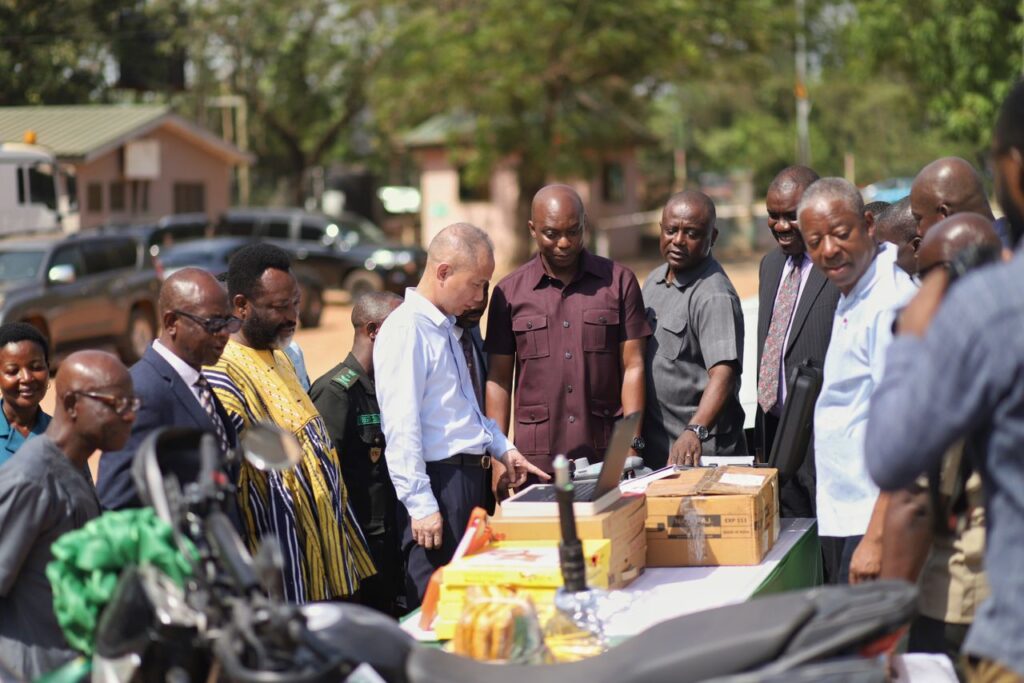
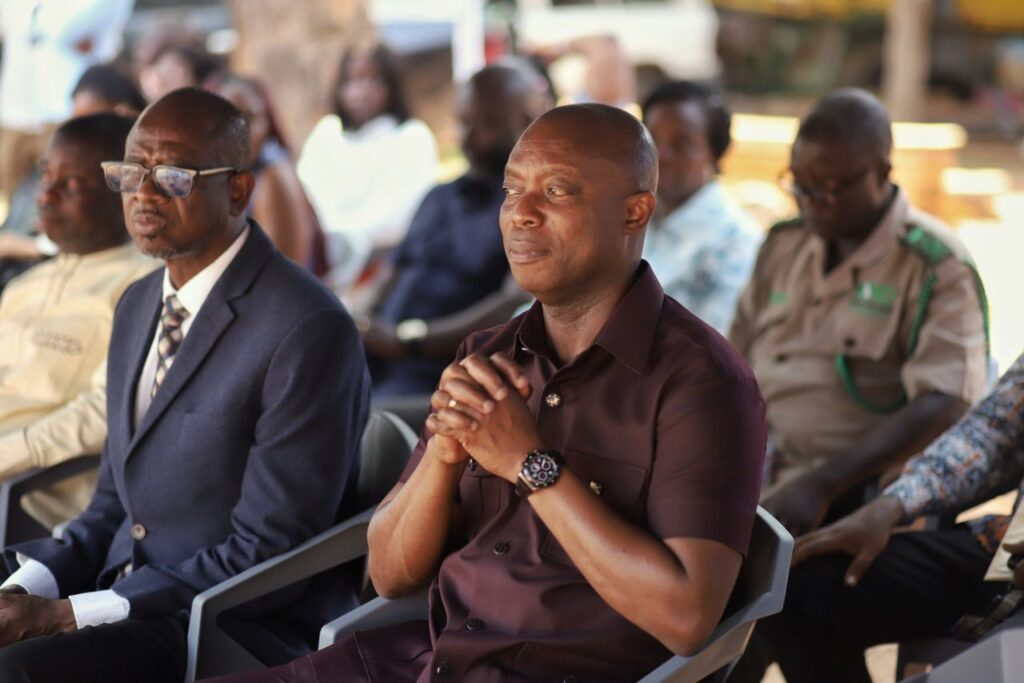
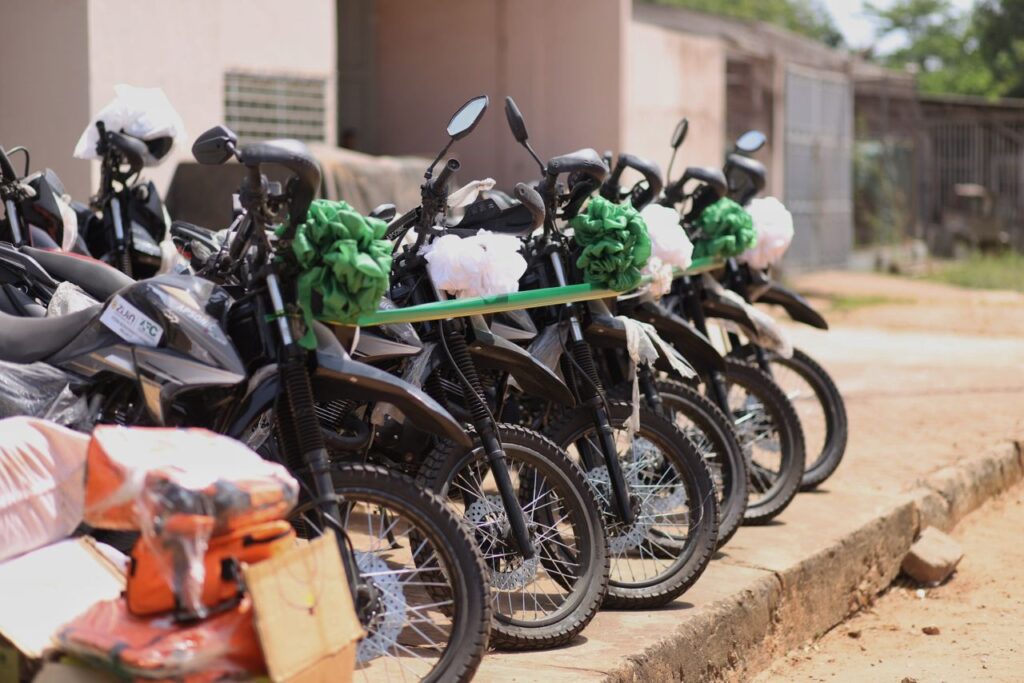
The logistics handover ceremony in March 2026, marked a significant moment of transition. Operational vehicles, monitoring drones, communication equipment, and a mobile audiovisual van — provided by ZGRL to the Forestry Commission — represent the practical infrastructure of conservation at scale. Boots on the ground. Eyes in the forest. Information reaching remote villages.
In 2026, the programme moves into its most intensive phase. Close to 1,500 hectares are earmarked for enrichment planting — a dramatic step up from the 60-hectare pilot — alongside 500 hectares of active restoration. The planting programme includes the Cola boxiana, a threatened tree species identified as a Key Biodiversity Value in the original environmental impact assessment for the Akyem Mine.
The programme will run through to at least 2035, with annual monitoring, independent verification of ecological outcomes, and public reporting through ZGRL’s ESG reporting framework. Longterm governance arrangements are being developed to ensure that conservation gains outlast the project period itself.
A model worth watching
Ghana’s forest reserves are national assets. They provide water, store carbon, shelter biodiversity, and sustain the livelihoods of millions of forest-fringe communities. Their protection is not the responsibility of conservation agencies alone — it is a shared obligation that extends to every actor whose work affects them.
The Atewa Biodiversity Offset Project is significant not only because of its scale, but because of what it represents: a mining company accepting full ecological accountability for its footprint, in partnership with the national institution responsible for Ghana’s forests, guided by international conservation standards, and anchored in the communities that depend on the forest most.
It is, as Zijin Golden Ridge Limited describes it, Ghana’s first large-scale mining biodiversity offset. Whether it becomes a model that others follow will depend on what the next decade delivers.
The forest is watching.