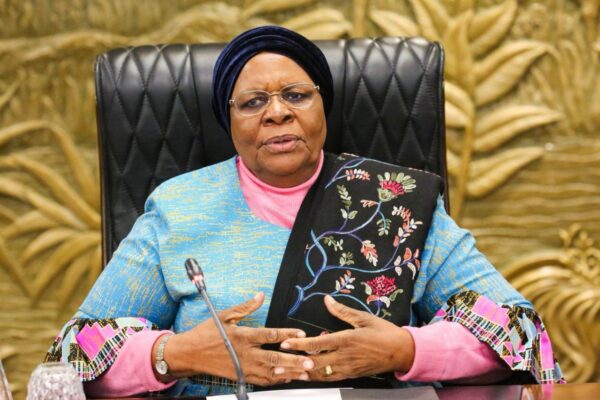
Namibia’s President, Netumbo Nandi-Ndaitwah, has revealed that neither she nor any members of her immediate family hold direct or indirect interests in Namibia’s oil and gas industry, as investment activity in the sector continues to accelerate.
Nandi-Ndaitwah said her children, like all Namibian citizens, retain the right to participate in lawful economic activities, but stressed that her family has no involvement in the country’s petroleum sector.
“Like any Namibian citizen, my children have the full and equal right to participate in the country’s economy. They do so to contribute to national development, the well-being of our people, and their own lawful livelihoods. We will not be faulted for exercising this right as long as it is done within the confines of the law” she said.
This follows the President’s decision to place oversight of Namibia’s emerging oil and gas sector under the Presidency, a move intended to ensure closer supervision of an industry still in its early stages.
Her remarks come as Namibia’s oil and gas industry continues to attract strong local and international interest following major offshore discoveries in the Orange Basin since 2022.
Key discoveries include Galp’s Mopane find, estimated at around 10 billion barrels, with operatorship expected to transfer to TotalEnergies. TotalEnergies’ Venus-1X discovery, estimated at about 5.1 billion barrels, is targeting a final investment decision by late 2026.
Exploration activity is also set to intensify. Shell plans to undertake further exploration drilling in PEL 39 in 2026, while Rhino Resources plans to drill an appraisal well and conduct a flow test offshore Namibia as it moves to fast-track its discoveries and target first oil production by 2030.
The company, in partnership with Azule Energy, a BP–Eni joint venture, aims to reach its own final investment decision by late 2026 or early 2027.
Namibia is expected to generate about US$1.3 billion from 11 exploration and appraisal wells planned for 2025–2026, as drilling activity continues both offshore and onshore.
The oil and gas sector is regarded as a strategic pillar of Namibia’s economic outlook, with first oil currently expected between 2029 and 2030. Development of the sector is expected to support economic growth, energy diversification and investment.
According to the Oil and Gas Industrial Baseline Survey conducted by Deloitte Namibia, Namibia’s gross domestic product is forecast to grow by between 5% and 8% annually, driven largely by oil and gas development.
The survey estimates that during the production phase, the sector could contribute an average of US$648 million, equivalent to about N$11.5 billion, to GDP each year.
During the construction phase, oil and gas activities are expected to contribute an average of US$113 million, or roughly N$2 billion, annually, supported mainly by higher operating surplus and increased income for skilled labour.
Source: Miningand energy.com.na