The Minister for Lands and Natural Resources, Emmanuel Armah-Kofi Buah, has announced that the first batch of mining equipment under the Responsible Cooperative Mining and Skills Development Programme (rCOMSDEP) will be deployed to Birim North, describing the district as one of Ghana’s largest mining areas and a strategic starting point for the government’s new approach to responsible mining.
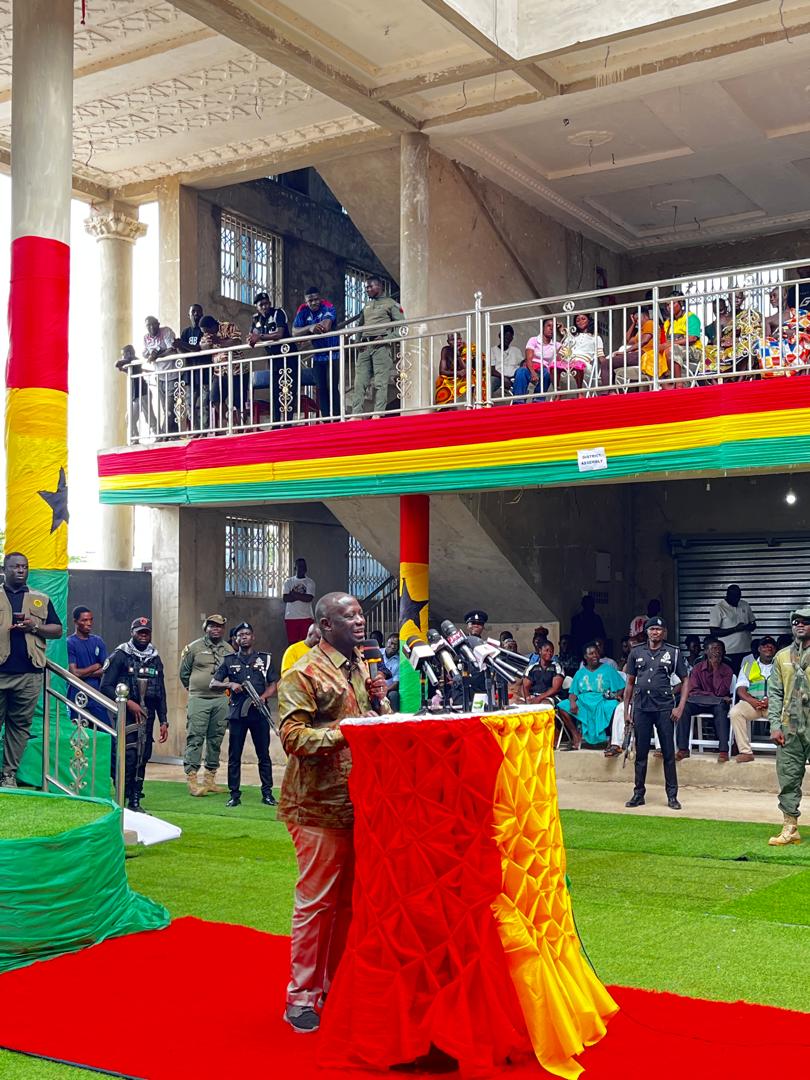
Launching the initiative at the Akyem Kotoku Area in New Abirem on Monday, June 8, the Minister said the programme is designed to move miners away from primitive and environmentally harmful mining practices by providing modern equipment, skills training, and a regulated framework for community-based mining.
According to Mr. Buah, many small-scale miners currently lose a significant portion of their gold during the recovery process because they rely on manual methods.
He explained that with the introduction of modern mining equipment under rCOMSDEP, miners would be able to recover up to 98 per cent of the gold they mine, compared to the lower yields obtained through traditional hand-washing methods.
“People are working hard but getting very little because of the rudimentary methods they use. With the equipment we are bringing, they will be able to recover almost all the minerals and earn more from their labour,” he said.
Fighting galamsey through responsible mining
Mr. Buah said the government’s fight against illegal mining, commonly known as galamsey, is being pursued through a multi-pronged approach that includes the Blue Water Guard Initiative, the National Anti-Illegal Mining Operations Secretariat (NAIMOS), strengthened regulation of mining activities, the establishment of District Mining Committees, and the rollout of rCOMSDEP.
He noted that among the various interventions, rCOMSDEP is attracting significant attention because it seeks to provide a practical alternative to illegal mining by equipping Ghanaians with the skills and resources needed to operate responsibly.
The Minister disclosed that President John Dramani Mahama has fully endorsed the initiative and supports greater Ghanaian participation and ownership in the mining sector.
He said the programme is open to Ghanaians interested in both small-scale and large-scale mining, adding that the government is also introducing a medium-scale mining category to enable miners who wish to expand their operations to do so within a regulated framework.
“This programme is about ensuring that Ghanaians benefit directly from their natural resources while protecting the environment and creating decent jobs,” he said.
District committees to regulate mining permits
As part of measures to strengthen oversight and community participation, Mr. Buah announced that District Mining Committees would be established to review mining applications and make recommendations.
Under the new arrangement, he said, individuals seeking to mine outside their home districts or regions would require recommendations from the district-level committee before obtaining permits from the Environmental Protection Agency (EPA) and the Minerals Commission.
The Minister said the move is intended to ensure that local communities have a say in mining activities taking place within their jurisdictions and to prevent unregulated operations.
He further revealed that he has directed both the EPA and the Minerals Commission to facilitate the certification process for individuals who have already undergone training under the programme.
No harassment for certified miners
The Eastern Regional Minister, Rita Akosua Adjei Awatey, welcomed the launch of the programme and commended the Ministry of Lands and Natural Resources for introducing what she described as a transformative initiative for mining communities.
She assured prospective participants that those who successfully complete the training and receive certification would be recognised as legitimate miners.
“After the training and certification, no police officer should harass you because you would be operating legally and within the framework established by government,” she said.
Ms. Awatey encouraged young people across the region to take advantage of the programme, stressing that it would equip them with employable skills while reducing unemployment.
She added that the government intends to train all interested youth under the initiative to ensure that more people benefit from responsible mining opportunities.
Community development fund
The National Coordinator of rCOMSDEP, Ama Mawusi Mawuenyefia, disclosed that some residents in Birim North have already completed training under the programme.
She explained that beyond individual earnings, mining communities participating in the initiative would also benefit collectively through a development fund.
According to her, a portion of proceeds generated from mining activities would be channelled into community development projects to improve local infrastructure and livelihoods.
“Some people in Birim North have already been trained and certified. The programme is not only about individual miners making money; the community itself will benefit through a development fund created from mining proceeds,” she said.
Reporting by Abigail Teye from Akyem Kotoku