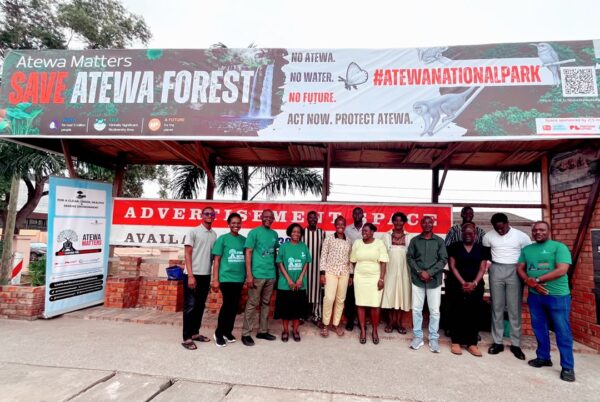
Civil society group, Eco-Conscious Citizens has unveiled a campaign banner at the Eco Bus Stop in Accra as part of efforts to raise public awareness and support for the protection of the Atewa Forest Reserve.
The campaign seeks to draw attention to the forest’s ecological importance and calls for it to be declared a National Park.
The Executive Director of Eco-Conscious Citizens, Awula Serwah, said Atewa is the source of the Birim, Ayensu and Densu rivers, which provide drinking water to more than five million Ghanaians.

She warned that pollution and degradation of the forest could threaten the water supply of millions of people, while also endangering its rich flora and fauna.

She commended JCS Investments Limited for supporting the campaign through the provision of the eco-friendly bus stop.
The Chief Executive Officer of JCS Investments, Patricia Safo, said greater public awareness and action were needed to protect the environment.
She said the company supported the eco-centric bus stop in collaboration with the relevant municipal authorities to provide a public platform for highlighting environmental concerns.
Ms Safo urged the public to consider the environmental impact of their daily activities and make choices that contribute to sustainability.
Atewa Forest: A Critical Ecosystem Under Threat
The Atewa Range Forest Reserve is internationally recognised as one of West Africa’s highest-priority ecosystems, owing to its rich biodiversity, high levels of endemism and critical hydrological importance.
Established as a National Forest Reserve in 1926, Atewa was designated a Special Biological Protection Area in 1994 and a Hill Sanctuary in 1995. In 1999, it was listed among Ghana’s 30 Globally Significant Biodiversity Areas (GSBAs).
The forest is the source of three major rivers—the Ayensu, Densu and Birim—which provide water to an estimated five million Ghanaians, making Atewa a critical water resource for the region.
However, the forest has faced persistent threats, particularly illegal chainsaw logging since the 1990s. The situation has worsened over the years, prompting the deployment of security personnel to help protect the reserve.
The growing degradation has raised concerns among residents and environmental advocates about the long-term impact on livelihoods, biodiversity and water security.
# Make a Atewa a National Park
# Make a Atewa a National Park
# Make a Atewa a National Park