The Trump administration's push to boost critical minerals production by regulating prices is facing skeptical G7 allies and a divided mining industry, with negotiations for a Western trading bloc stumbling over concerns about the plan's cost and governance, according to diplomatic sources and a Reuters analysis of corporate policy recommendations. First proposed by U.S. Vice …
Trump’s critical minerals pricing plan faces skeptical G7, divided industry
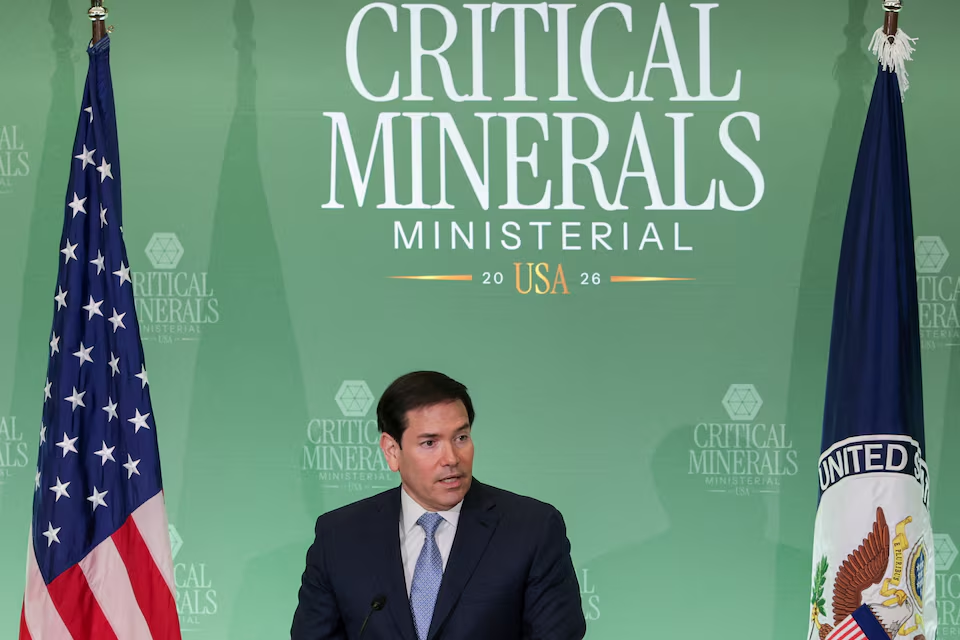
The Trump administration’s push to boost critical minerals production by regulating prices is facing skeptical G7 allies and a divided mining industry, with negotiations for a Western trading bloc stumbling over concerns about the plan’s cost and governance, according to diplomatic sources and a Reuters analysis of corporate policy recommendations.
First proposed by U.S. Vice President JD Vance in February, the trading bloc aims to help the West wean itself off China, which became the world’s largest minerals producer by operating at a loss and dampening prices for the building blocks of semiconductors, computer servers, military equipment and myriad other products.
The Reuters Inside Track newsletter is your essential guide during the World Cup. Sign up here.
Artificially low prices for cobalt, lithium, nickel and other minerals have made it harder for Western mining rivals to compete, inhibiting new development and driving some companies out of business — a tactic Beijing has used repeatedly in other industries.
The trade bloc, as envisioned, would explore price supports, market standards, subsidies, or guaranteed purchases to encourage and financially underpin production across multiple countries. The measures could be enforced by “adjustable tariffs to uphold pricing integrity,” Vance said at the time.
At present, many niche minerals critical to tech and defense are traded over-the-counter with minimal transparency and linked to Chinese prices, which de facto set the global market due to China’s dominant production.
Since Vance’s announcement, G7 members have pushed back against U.S. Trade Representative Jamieson Greer in private negotiations and cooled on the idea of the bloc relying on a price scheme derived from a Pentagon AI model, three sources told Reuters.
Key concerns center around who would pay a premium for minerals, how far down the supply chain those subsidies should go and how governance would work, according to European officials.
The U.S. mining industry is divided on what steps Greer should push allies to support, a disagreement that is clear from more than 230 public submissions sent to Greer’s office by a range of miners, refiners and their customers reviewed by Reuters.
Allied and corporate concerns underscore the complexity of reinventing the way minerals are bought and sold. Yet how and whether the trade bloc ultimately shapes out could influence minerals markets for years to come, more than a dozen analysts and consultants told Reuters.
The specifications of this robot is that it can shoot up to 60 metres plus 2400 litres per minute, so that’s about 40 litres per second.
“It is a very hard thing to do, and I’m happy I’m not the one doing it,” said Ashley Zumwalt-Forbes, a minerals investor who ran the U.S. Department of Energy’s batteries and critical minerals portfolio under former President Joe Biden.
The topic will be a key talking point as G7 members meet this week in France. Western countries face the difficult task of building up a supply chain from mine to end product all at once to diversify away from China.
The draft U.S. proposal, crafted using an AI pricing program created by the Pentagon’s Defense Advanced Research Projects Agency (DARPA), has been delivered to the White House and the National Security Council and U.S. representatives are expected to brief G7 allies on its contents in the upcoming meeting, according to a U.S. official.
European and industry officials said they want to study the impact of price supports on the medium and long-term rather than commit to quick deals — at odds with the faster-paced Americans.
Reuters