Making mining safe and environmentally sustainable is non-negotiable. People and the environment form the foundation of life and drive socio-economic development. This principle defines the professional journey of Benitta Wiafe. Born in Kumasi, Benitta began her primary education at Kumasi Buokrom M/A Primary School. She later moved to Burma Camp in Accra, where she continued …
Ghanaian Scholar Benitta Wiafe making impact in global mining industry

Making mining safe and environmentally sustainable is non-negotiable. People and the environment form the foundation of life and drive socio-economic development.
This principle defines the professional journey of Benitta Wiafe.
Born in Kumasi, Benitta began her primary education at Kumasi Buokrom M/A Primary School. She later moved to Burma Camp in Accra, where she continued at the 1st Signal Regiment Basic School. She eventually returned to Kumasi to complete her basic education at Kings International School at Airport Roundabout and her junior high education at Oniwaa Memorial School at Tafo Nhyiaeso. She then proceeded to Asanteman Senior High School for her secondary education.
In 2012, she gained admission to the University of Ghana to pursue a bachelor’s degree in Earth Science. Her undergraduate research focused on slope stability. Using the Accra–Aburi Road as a case study, she worked with the approval and support of Ghana’s Ministry of Lands and Natural Resources to assess the structural integrity of slopes along the highway.
Her work examined the causes of recurring slope failures that posed risks to public safety and the environment. The findings and recommendations from the research have recently been published in the International Journal of Engineering Research and Development.
After completing her undergraduate studies, Benitta worked with the Environmental Protection Agency of Ghana, where she gained practical experience in environmental management and regulatory practices. She also served as a Geotechnical Assistant at the Building and Road Research Institute of the Council for Scientific and Industrial Research (CSIR) in Kumasi.
She later received a scholarship to pursue a master’s degree in Environmental Engineering at Suzhou University of Science and Technology in China. There, her research focused on water pollution, particularly arsenic contamination in soil and groundwater. Arsenic is a toxic element that is not visible to the human eye in water or soil, yet even small amounts can harm human health.
Global studies estimate that millions of people are exposed to arsenic-contaminated drinking water, with significant health consequences in affected regions. Benitta’s work involved monitoring and identifying arsenic contamination to support mitigation efforts.
She subsequently moved to the United States, where she completed a second master’s degree in Mining Engineering at Michigan Technological University in 2024. She currently works as a Mining Engineer at Nevada Gold Mines, where she contributes to initiatives that promote safe, efficient, and environmentally responsible mining operations.
Beyond her professional work, Benitta continues to engage in research that advances the field of mining engineering. Her focus is on sustainable mining, with an emphasis on developing systems and frameworks that improve operational efficiency while minimizing environmental and safety risks.
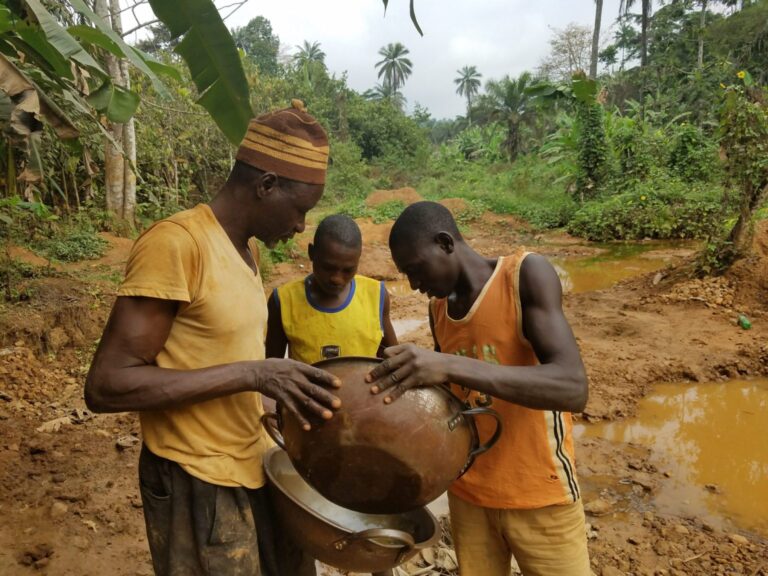
She has published in international journals, including Resources Policy. In one study, she highlights that without strong commitment, strategic oversight, and deliberate formalization, small-scale mining will remain environmentally damaging and unsafe. In related work, she and her colleagues found that certain military-led approaches to formalizing small-scale mining can disproportionately affect local miners and may unintentionally worsen environmental and safety outcomes.
Benitta’s work has far-reaching implications for the future of mining. As demand for minerals continues to grow, ensuring that mining is conducted safely and sustainably is essential. Through her work, she is contributing to a more responsible and resilient mining industry.
By Kenneth Bansah, PhD, PE