Not even the ridicule from some classmates and friends could stop him from aiming higher and pushing forward. Growing up in Anwomaso in Kumasi, in a home that was financially stretched, Benjamin had to support his mother by selling fanti kenkey on the streets. His father? Absent, living thousands of miles away in another country. …
Mocked for selling kenkey, now safeguarding mines: Benjamin Abankwa’s Story
Not even the ridicule from some classmates and friends could stop him from aiming higher and pushing forward.
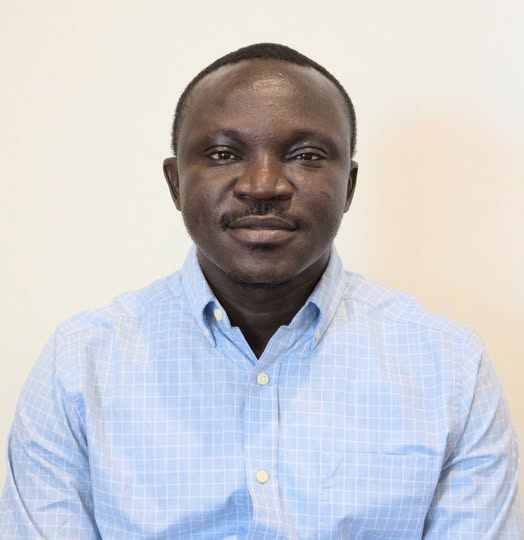
Growing up in Anwomaso in Kumasi, in a home that was financially stretched, Benjamin had to support his mother by selling fanti kenkey on the streets. His father? Absent, living thousands of miles away in another country. Some friends mocked him for selling kenkey, but for Benjamin, that was not the point. He was determined to push through and make a difference for himself, his family, and his community.
This is the story of Benjamin Abankwa.
As a young boy, he spent his mornings hawking kenkey with his mother before heading to school. This was his routine throughout his basic and junior high school years. He also worked as a cobbler, fixing worn-out shoes, slippers, and sandals to earn a little more to support home and school. At one point, he admitted, “I had to hide from my schoolmates.” Still, the difficult beginnings did not break him. They built resilience, strength, and determination in him.
With hard work and focus, Benjamin gained admission to Ghana National College in Cape Coast, where he studied General Science. He later moved to the Kwame Nkrumah University of Science and Technology (KNUST) to pursue a bachelor’s degree in Geological Engineering, graduating in 2013.
From there, he began building his career. He worked with the Geological Survey Authority of Ghana, Mates Engineering Limited, K. A. A. Engineering Services, and Ramoth Services Limited. His work focused on geotechnical engineering, making sure that major infrastructure projects are stable and safe under real environmental and ground conditions.
He also contributed to mining projects across Ghana, including AngloGold Ashanti’s Iduapriem and Obuasi mines, Chirano Gold Mine, and Gold Fields Ghana operations.
Benjamin’s main focus has been on tailings dam and mine infrastructure safety.
In mining, large volumes of waste are produced after extracting the valuable minerals. This waste can contain harmful substances and must be safely stored.
Engineers build structures called tailings dams to hold this waste. These structures must remain stable for many years and require careful design, monitoring, and management.
Benjamin is part of that effort. He applies his knowledge in geological, geotechnical, and mining engineering to support the safety of these facilities.
When these structures fail, the consequences are serious. In 2025, a tailings dam failure at the Sino-Metals Leach copper mine in Zambia released large volumes of acidic and toxic waste into the Kafue River. Aquatic life was destroyed, water supplies were shut down, and farmlands were affected. Similar incidents have happened in other parts of the world, including the Brumadinho disaster in Brazil, which claimed over 270 lives.
Benjamin’s work is focused on preventing such events. He develops systems to monitor these dams and detect early signs of problems so that action can be taken before failure occurs.
In 2022, he moved from Accra to the United States to pursue a master’s degree in Mineral Engineering, specializing in geotechnical engineering at the New Mexico Institute of Mining and Technology (New Mexico Tech). He received a scholarship and worked as a teaching and research assistant, helping students learn soil and rock laboratory testing.
In the summer of 2023, he interned with Freeport-McMoRan. His work stood out, and he was invited back the following summer. After completing his degree, he was offered a full-time role and now contributes to improving tailings dam safety and sustainability.
Alongside his work, Benjamin continues to carry out research. His publications are gaining attention, and he receives invitations to speak on tailings dam safety. He is also affiliated with professional organizations such as the Society for Mining, Metallurgy and Exploration, the American Society of Civil Engineers, and the International Association of Engineers.
Benjamin’s early struggles did not hold him back. They pushed him to keep going. Today, he is contributing to safer mining practices using modern tools, including data-driven monitoring and artificial intelligence.
His journey shows that where you begin does not limit where you can go. With focus, discipline, and determination, even the hardest paths can lead somewhere meaningful.
By Kenneth Bansah, PhD,